GENESIS Tutorial 14.2 (2022)
Absolute solvation free energy
0. Preparations
All the files required for this tutorial are hosted in the [GENESIS tutorials repository on GitHub] (https://github.com/genesis-release-r-ccs/genesis_tutorial_materials). If you haven’t downloaded the files yet, open your terminal and run the following command (see more in Tutorial 1.1):
$ cd ~/GENESIS_Tutorials-2022
# if not yet
$ git clone https://github.com/genesis-release-r-ccs/genesis_tutorial_materials
If you already have the tutorial materials, let’s go to our working directory:
$ cd genesis_tutorial_materials/tutorial-14.2
1. Alchemical calculation for absolute solvation free energy
The absolute solvation free energy, \(\Delta G_{\rm solv}\), is the free-energy change upon the transfer of a solute from vacuum to solvent. In Figure 1, we can see that the calculation of the absolute solvation free energy is a special case of the relative solvation free energy calculation (Figure 2 in Sec. 14.1), where molecule B is nothing. Molecule B has the same topology and force field parameters as molecule A, but the interactions of molecule B with the solvent molecules are turned off (i.e., fully decoupled from the system). The free-energy change from fully interacted state (molecule A) to fully decoupled state (molecule B), \(\Delta G_{\rm annih}^{\rm vacuum}\) and \(\Delta G_{\rm annih}^{\rm solvent}\), can be calculated by gradually annihilating the interactions of the solute in vacuum and in solvent, respectively. Thus, \(\Delta G_{\rm solv}\) can be calculated via the alchemical calculation paths (Figure 1):
where \(\Delta G_{\rm tr}\) is the change in the free energy of translational and rotational motion of the solute. In the fully decoupled state (molecule B), the solute can move freely in the simulation box both in vacuum and in solvent, resulting in \(\Delta G_{\rm tr}=0\). In this tutorial, we will demonstrate how to calculate \(\Delta G_{\rm annih}^{\rm vacuum}\) and \(\Delta G_{\rm annih}^{\rm solvent}\) using the FEP functions in GENESIS.
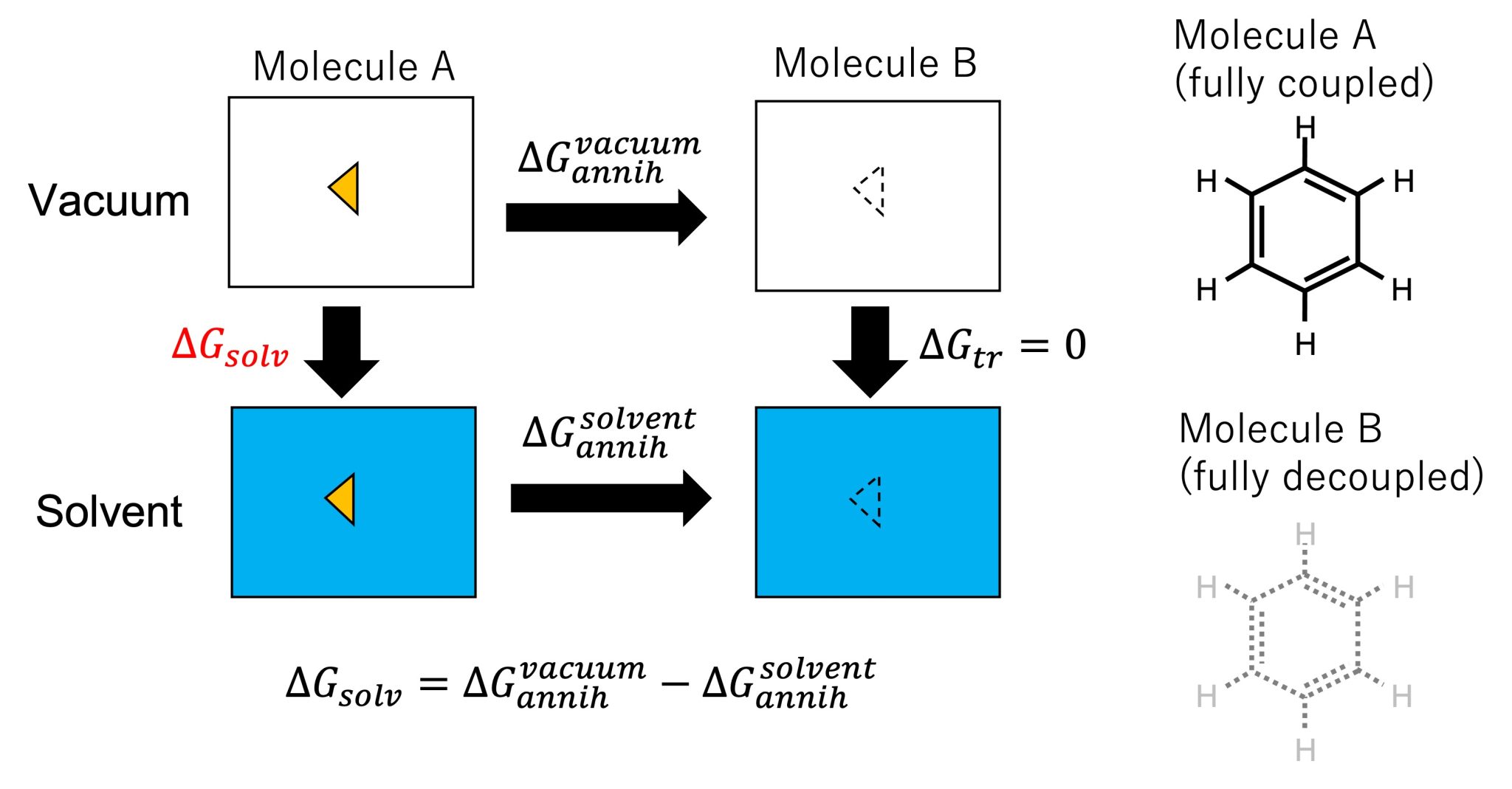
Figure 1. (Left) Thermodynamic cycle for calculating solvation free energy and annihilation of the solute. (Right) Molecules A and B.
2. System setup
2. 1. Overview of required input files
In this tutorial, we demonstrate the alchemical calculation of the
absolute solvation free energy for methane and methanol.
The tutorial consists of three directories: methane,
methanol, and toppar. The “methane” and “methanol” directories
include “ligand and vacuum directories, which contain input files
for FEP simulations in solvent and in vacuum, respectively. The
“toppar directory contains CHRAMM force field parameter files.
# Download the tutorial file
$ cd tutorial-14.2
$ ls
methane/  methanol/  toppar/
$ cd methane
$ ls
calc_dG.py  ligand/  README  vacuum/

# Setup the directory for binary files of GENESIS 2.1.X
$ export GENESIS_BIN_DIR=../../../GENESIS_Tutorials-2022/Programs/genesis-2.1.X/bin/
The ligand directory contains script files and input files for
calculating \(\Delta G_{\rm annih}^{\rm solvent}\). run_min.inp,
run_eq1.inp, run_eq2.inp, and run_eq3.inp are GENESIS control
files for minimization, heating, equilibration with restraints, and
equilibration without restraints, respectively. make_inp.sh is a shell
script for generating the control file for the production run of FEP
simulations. post_run.sh is a shell script for analysis. The vacuum
directory contains respective input files for calculating of \(\Delta G_{\rm annih}^{\rm vacuum}\).
$ cd ligand
$ ls
run_eq.sh*      ligand.psf      output/         run_eq2.inp     run_fep2.inp
run_fepremd.sh* make_input.sh*  post_run.sh*    run_eq3.inp     run_min.inp
ligand.pdb      make_job.sh*    run_eq1.inp     run_fep1.inp
2. 2. Structure files for the hybrid-topology approach
Unlike the relative solvation free energy calculations, in the absolute
solvation case, there is no target molecule (molecule B), i.e. the
single-topology part is nothing, thus there are no atoms corresponding
to singleA and singleB. Therefore, we do not use the hybrid topology
setup. We consider the solute as having only the dual-topology part
where dualA corresponds to the fully coupled solute, while dualB
corresponds to “nothing” (i.e., the solute has fully disappeared from the system). Figure 2 shows a section of the PDB file, which contains
only the coordinates of the solute (methane) corresponding to dualA,
and solvent molecules. It does not include a dualB part, because the
target state (state B) does not have any solute.
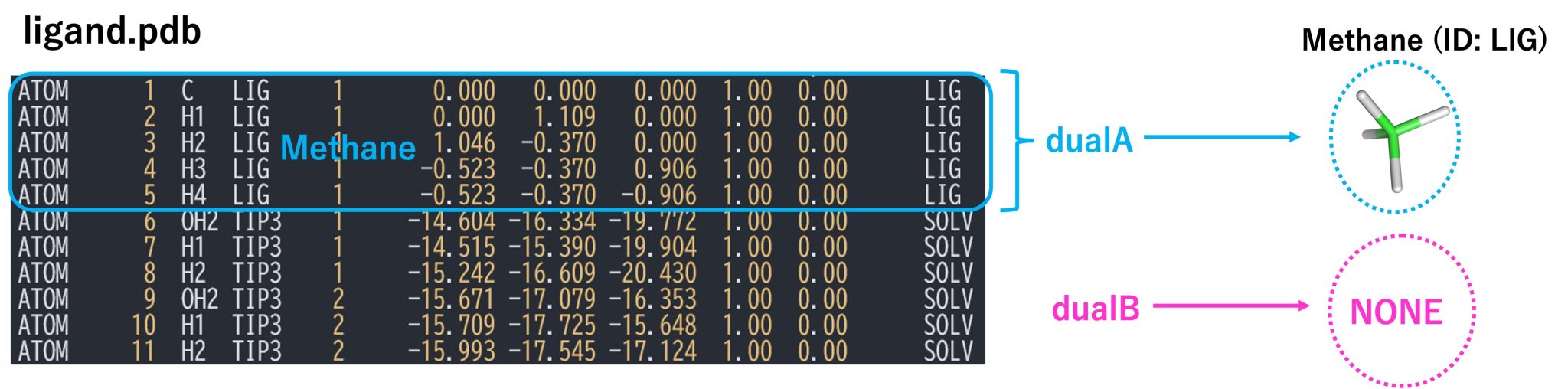
Figure 2. PDB file for the dual topology and definitions of dualA, and dualB.
The input files in tutorial-14.2.zip were generated by CHARMM-GUI Absolute Ligand Solvator, but some files were modified for the purpose of this tutorial.
3. FEP simulations in solvent
3. 1. Minimization and equilibration
We carry out minimization and equilibration of the system. As shown in
Figure 2, the system has only one solute, therefore we do not need
special treatment for overlaps or superimposition of molecules A and B.
We perform minimization and equilibration similarly to conventional MD
simulations, the [ALCHEMY] section is not included in run_min.inp,
run_eq1.inp, run_eq2.inp, and run_eq3.inp.
First, we carry out the minimization in order to remove atomic clashes in the initial structure. The following command executes the minimization procedure:
# Perform minimization
$ $GENESIS_BIN_DIR/spdyn -np 8 run_min.inp > output/run_min.out
Next, we heat up the system from 0.1 K to 300 K. The following command executes the heating procedure:
# Perform heating
$ $GENESIS_BIN_DIR/spdyn -np 8 run_eq1.inp > output/run_eq1.out
Subsequently, we perform NPT equilibration with restraints (100 ps) and NPT equilibration without restraints (100 ps). In those simulations, [ALCHEMY] is the same as the heating. After the simulations have ended, it is recommended to check the log files and confirm the trajectories using a visualization tool such as VMD.
# Perform equilibration with positional restraints
$ $GENESIS_BIN_DIR/spdyn -np 8 input/run_eq2.inp > output/run_eq2.out

# Perform equilibration without the restraints
$ $GENESIS_BIN_DIR/spdyn -np 8 input/run_eq3.inp > output/run_eq3.out
3. 2. FEP/\(\lambda\) REMD simulations
In this step, we perform the production run of FEP/REMD simulations. We prepare 24 replicas: The first and the last replicas correspond to the initial and final states, respectively, while the other 22 replicas correspond to intermediate states. 24 replicas run in parallel and exchange their parameters at fixed intervals during the simulation. Exchanges between adjacent replicas are accepted or rejected according to the Metropolis criterion 1,2.
We execute two 1-ns FEP/REMD simulations (run_fep1.inp and run_fep2.inp) sequientially for a total of a 2-ns simulation. Input
files for sequential runs can be easily generated by the following
command:
# Execute the shell script for generation of input files
$ sh make_inp.sh
The simulation time can be modified in the “make_inp.sh” script (5-ns by default). If 24 replicas are too large for the user’s computer
resources, it is recommended to use the “embarrassingly parallel computing” option by modifying make_inp.sh (see Sec 14.1.6).
The most important sections in run_fep1.inp are shown below. In the
FEP/REMD simulation, [REMD] section is also required. type1 is set
to alchemy, meaning that \(\lambda\) values are exchanged.
exchange_period should be a multiple of fepout_period. nreplica1
specifies the number of replicas. In the [ALCHEMY] section,
fep_direction is set to Bothsides. Figure 3 shows the fepfile file
for replica 1 (= window 1). The fepfile files are used to calculate the
free energy in the next section “4. Analysis”. Here we use the
dual-topology approach,
“fep_topology = [dual]”. Since there are no
single-topology parts, singleA and singleB are set to NONE.
dualA is set to the group ID specified in the [SELECTION] section,
while dualB is set to NONE. This specifies that there is no target
state (molecule B is nothing) and only the interactions of molecule A
are scaled according to the \(\lambda\) values. The parameters for LJ
and electrostatic soft-core potentials 3,4 are set to 5.0 and 0.5,
respectively (sc_alpha=5.0 and sc_beta=0.5). The parameters for
specifying \(\lambda\) values for each replica are
lambljA, lambljB, lambelA, lambelB, lambbondA, lambbondB, and
lambrest, but in this case only lambljA and lambelA are used
(lambljB, lambelB, lambbondA, lambbondB, and lambrest can have any values). As shown in Figure 4, we start by linearly changing lambelA
from 1.0 to 0.0 (replica 1 to replica 11). After annihilating the
electrostatic interactions, we gradually change lambljA from 1.0 to
0.0 (replica 12 to replica 24). Since the energy difference often
becomes very large near lambljA = 0, more intermediate states should
be inserted in order to reduce statistical errors.
[REMD]
dimension = 1
exchange_period = 800
type1 = alchemy
nreplica1 = 24

[ALCHEMY]
fep_direction = BothSides
fep_topology = dual
singleA = NONE
singleB = NONE
dualA   = 1
dualB   = NONE
fepout_period = 400
equilsteps = 0
sc_alpha   = 5.0
sc_beta    = 0.5
lambljA       = 1.000 1.000 1.000 1.000 1.000 1.000 1.000 1.000 1.000 1.000 \
                1.000 0.900 0.800 0.700 0.600 0.500 0.400 0.300 0.200 0.150 \
                0.100 0.050 0.025 0.000
lambljB       = 0.000 0.000 0.000 0.000 0.000 0.000 0.000 0.000 0.000 0.000 \
                0.000 0.000 0.000 0.000 0.000 0.000 0.000 0.000 0.000 0.000 \
                0.000 0.000 0.000 0.000
lambelA       = 1.000 0.900 0.800 0.700 0.600 0.500 0.400 0.300 0.200 0.100 \
                0.000 0.000 0.000 0.000 0.000 0.000 0.000 0.000 0.000 0.000 \
                0.000 0.000 0.000 0.000
lambelB       = 0.000 0.000 0.000 0.000 0.000 0.000 0.000 0.000 0.000 0.000 \
                0.000 0.000 0.000 0.000 0.000 0.000 0.000 0.000 0.000 0.000 \
                0.000 0.000 0.000 0.000
lambbondA     = 1.000 1.000 1.000 1.000 1.000 1.000 1.000 1.000 1.000 1.000 \
                1.000 1.000 1.000 1.000 1.000 1.000 1.000 1.000 1.000 1.000 \
                1.000 1.000 1.000 1.000
lambbondB     = 0.000 0.000 0.000 0.000 0.000 0.000 0.000 0.000 0.000 0.000 \
                0.000 0.000 0.000 0.000 0.000 0.000 0.000 0.000 0.000 0.000 \
                0.000 0.000 0.000 0.000
lambrest      = 1.000 1.000 1.000 1.000 1.000 1.000 1.000 1.000 1.000 1.000 \
                1.000 1.000 1.000 1.000 1.000 1.000 1.000 1.000 1.000 1.000 \
                1.000 1.000 1.000 1.000

[SELECTION]
group1 = segid:LIG
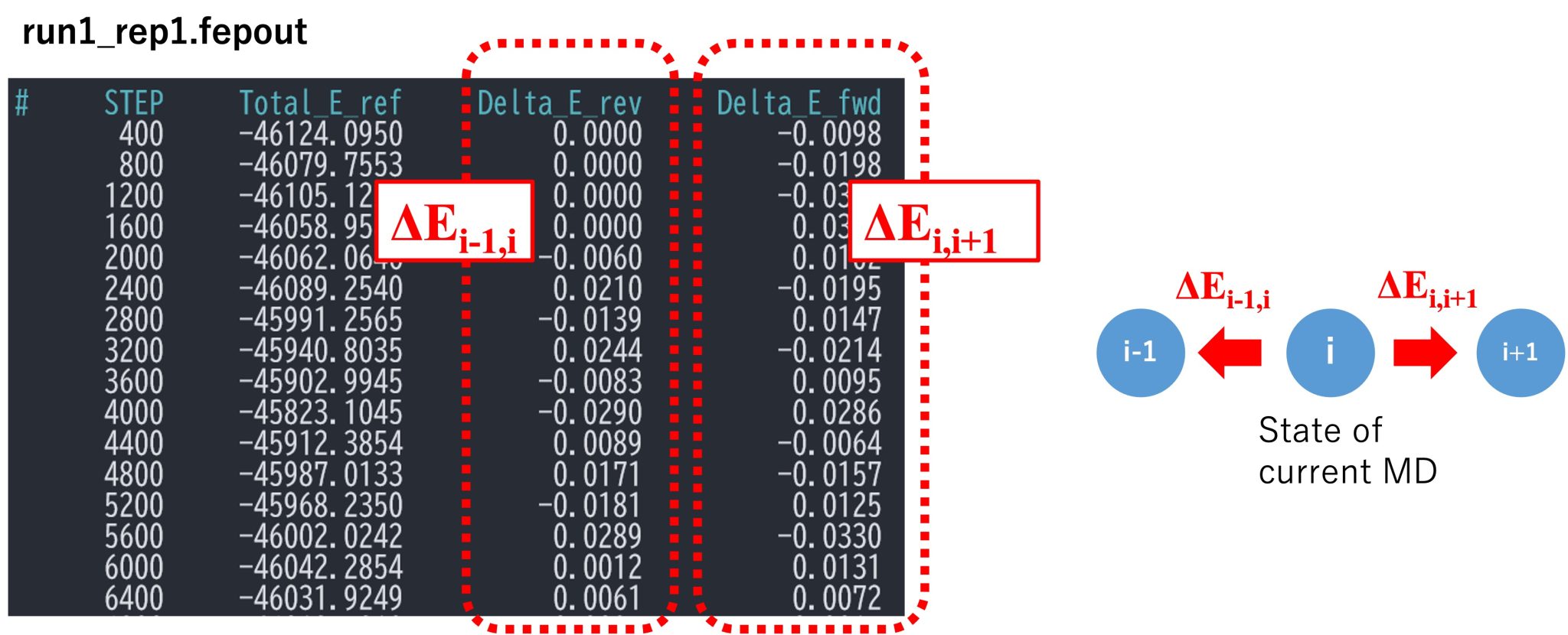
Figure 3. A section of fepfile file.
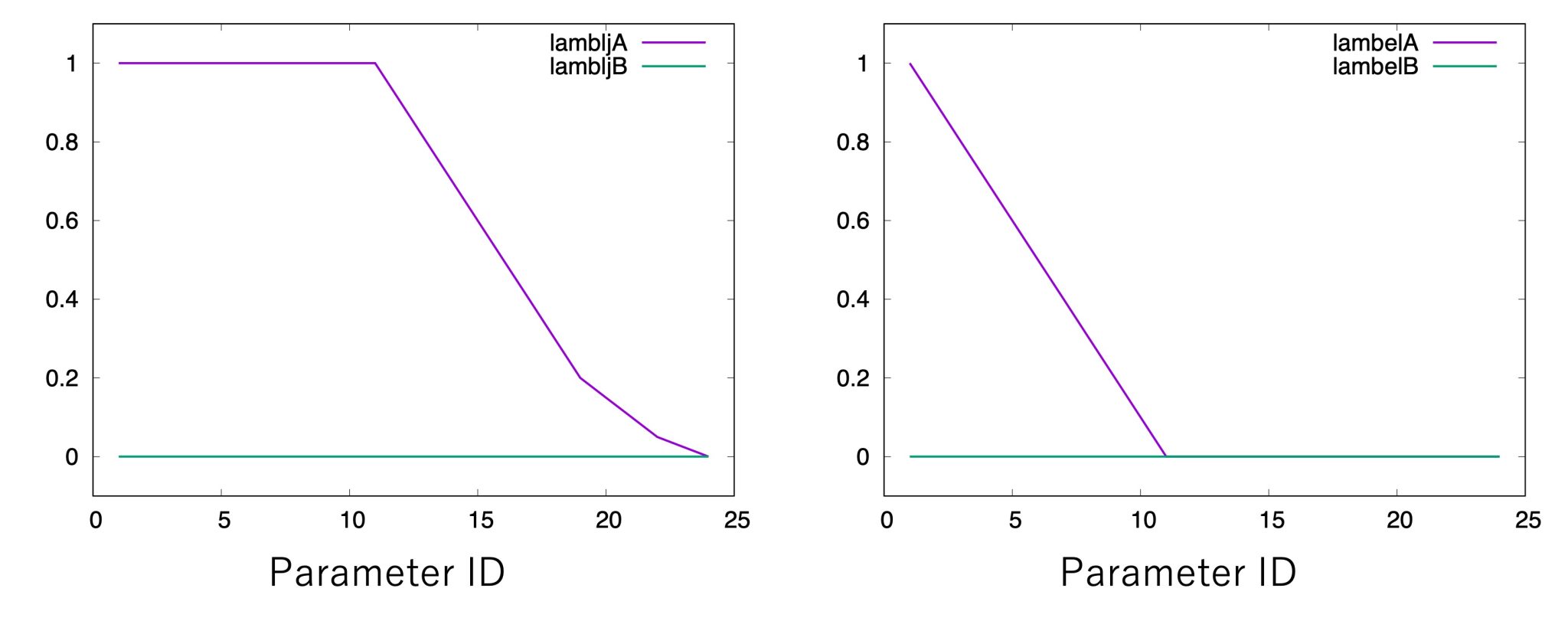
Figure 4. Values of λ for electrostatic and LJ interactions.
The following command executes the FEP/\(\lambda\)REMD simulation:
# Execute the control file for the lambda-exchange FEP simulation
# 8 MPI processes per replica, i.e. 8 * 24 = 192 processes are used here
$ $GENESIS_BIN_DIR/spdyn -np 192 input/run_fep1.inp > output/run_fep1.out
We perform a FEP/\(\lambda\)REMD simulation using the r-RESPA integrator with a 2.5-fs time step. Here, the length of the simulation is 2 ns, which might not be sufficient for the convergence of the free-energy calculation. For obtaining more accurate results, it is recommended to use a longer simulation time, in accordance with the computational resources or time available for the user.
3. 3. Analysis
After the FEP/\(\lambda\)REMD simulations have ended, we calculate
the free energy from the fepfile files. The post_run.sh script calculates the free-energy difference between the
initial and final states:
# Execute the shell script for analysis
$ sh post_run.sh
In the first part of the post_run.sh script, fepfile files are
sorted using remd_convert and energy differences for each parameter
are outputted (par1.fepout to par24.fepout). After sorting, the
free-energy differences between the reference state (state A = fully coupled) and the target state (state B = fully decoupled) are calculated
using mbar_analysis in GENESIS analysis tool. Finally, post_run.sh
outputs a file named fene.dat (Figure 5). By default, the trajectories
are divided into three blocks, and each column in fene.dat represents
the free-energy changes in each block (i.e., the block average of the free-energy changes are obtained). Each row represents the free-energy
change from the initial state (state A). The last row corresponds to the
free-energy change from the initial state to the final state (state B),
which is equal to \(\Delta G_{\rm annih}^{\rm solvent}\).
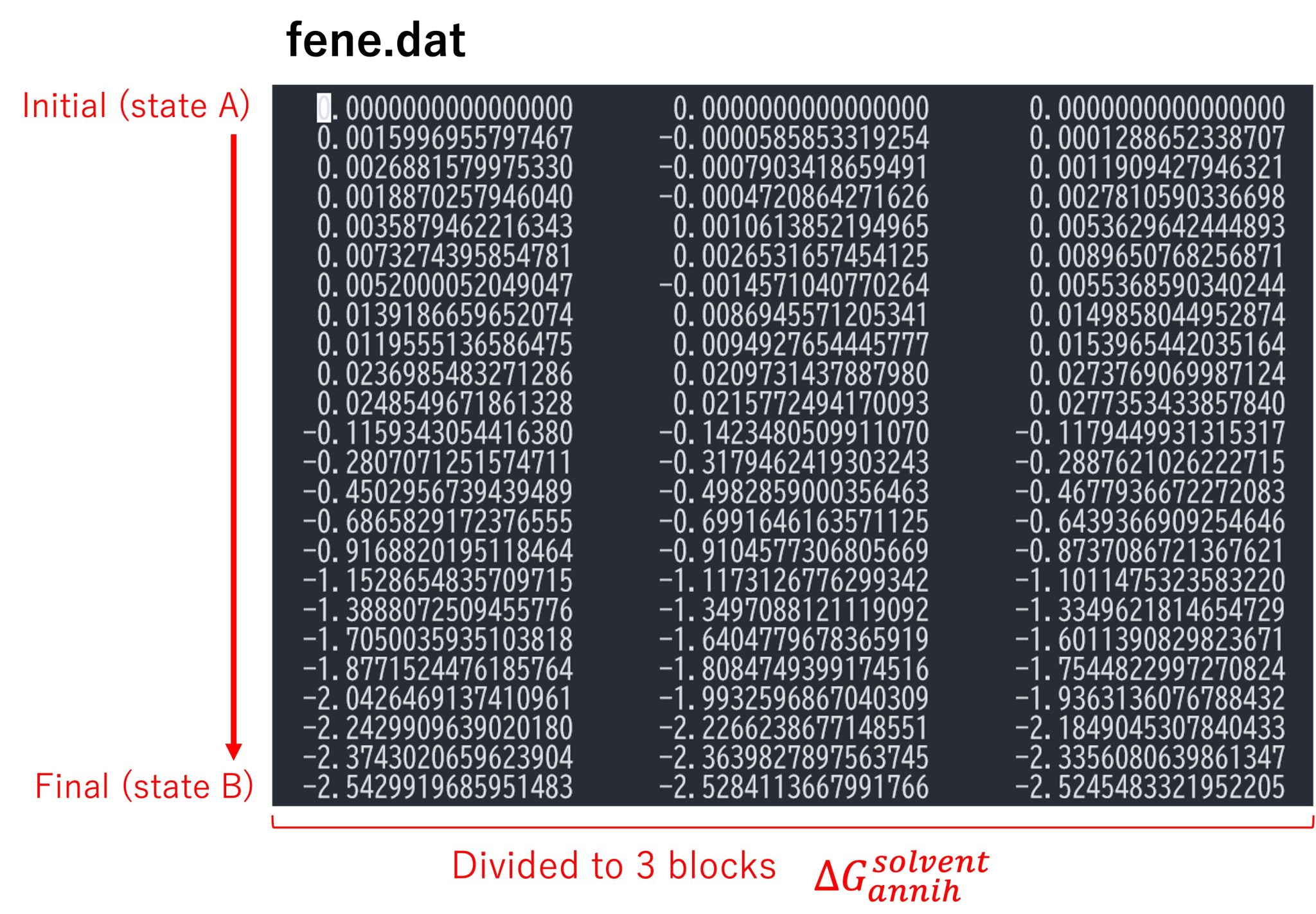
Figure 5. Free-energy changes from the initial state to the final state in the solvent.
4. FEP simulations in vacuum
Next, we perform FEP simulations in vacuum to obtain \(\Delta G_{\rm annih}^{\rm vacuum}\) . Please change directory to vacuum. Input
files for the vacuum simulations are very similar to those for the
solvent simulations, but there are some important differences described
as follows. There are no water molecules in vacuum.pdb and
vacuum.psf. In run_min.inp, run_eq[1-3].inp, and
run_fep[1-2].inp, vacuum option is set to “YES”. CUTOFF is used for
energy evaluation instead of PME. The cutoff distance should be set to a
sufficiently large value (here we use 300 Å). The box size should be
consistent with the large pairlist distance. Also, NVT should be used in
order to fix the simulation box size. If NPT is used in the vacuum
simulation, the box size shrinks drastically, which can lead to an early
termination of the simulation.
[ENERGY]
forcefield       = CHARMM       # [CHARMM]
electrostatic    = CUTOFF       # [CUTOFF,PME]
switchdist       = 298.0        # switch distance
cutoffdist       = 300.0        # cutoff distance
pairlistdist     = 305.0        # pair-list distance
vdw_force_switch = YES
vacuum           = YES

[BOUNDARY]
type            = PBC           # [PBC]
box_size_x      = 921
box_size_y      = 921
box_size_z      = 921
Similarly to FEP simulations in solvent, after performing minimization,
equilibration, and FEP/\(\lambda\)REMD simulations, we can obtain
\(\Delta G_{\rm annih}^{\rm vacuum}\) by executing post_run.sh.
5. Calculation of \(\Delta G_{\rm solv} \) and \(\Delta\Delta G_{\rm solv} \) and comparison with experimental values
Figure 6 shows the free-energy changes of methane and methanol. The free-energy changes in window ID 24 for “in solvent” and “in vacuum” correspond to \(\Delta G_{\rm annih}^{\rm solvent}\) and \(\Delta G_{\rm annih}^{\rm vacuum}\), respectively.
For methane, we obtained \(\Delta G_{\rm annih}^{\rm solvent} = -2.53±0.01\) kcal/mol and \(\Delta G_{\rm annih}^{\rm vacuum} = 0.00±0.00\) kcal/mol, resulting in \(\Delta G_{\rm solv} = 2.53±0.01\) kcal/mol. For methanol, we obtained \(\Delta G_{\rm annih}^{\rm solvent} = -10.94±0.03\) kcal/mol and \(\Delta G_{\rm annih}^{\rm vacuum} = -15.32±0.01\) kcal/mol, resulting in \(\Delta G_{solv} = -4.83±0.03\) kcal/mol. The experimental values of \(\Delta G_{\rm solv} \) for methane and methanol are 2.00 and -5.10 kcal/mol 5, respectively, which is in good agreement with the calculated results. The difference between the solvation free energies of methane and methanol (i.e., the relative solvation free energy) is \(\Delta\Delta G_{\rm solv} = −6.91±0.03\) kcal/mol, which is almost the same as the value obtained in section 14.1. We see that the absolute solvation free energy calculations (\(\Delta\Delta G_{\rm solv} = \Delta G_{\rm solv}^{\rm methanol} – \Delta G_{\rm solv}^{\rm methane} \)) are consistent with the relative solvation free energy calculations (\(\Delta\Delta G_{\rm solv} = \Delta G_{\rm mut}^{\rm solvent} – \Delta G_{\rm mut}^{\rm vacuum} \)) as shown in Figure 2 in Section 14.1.
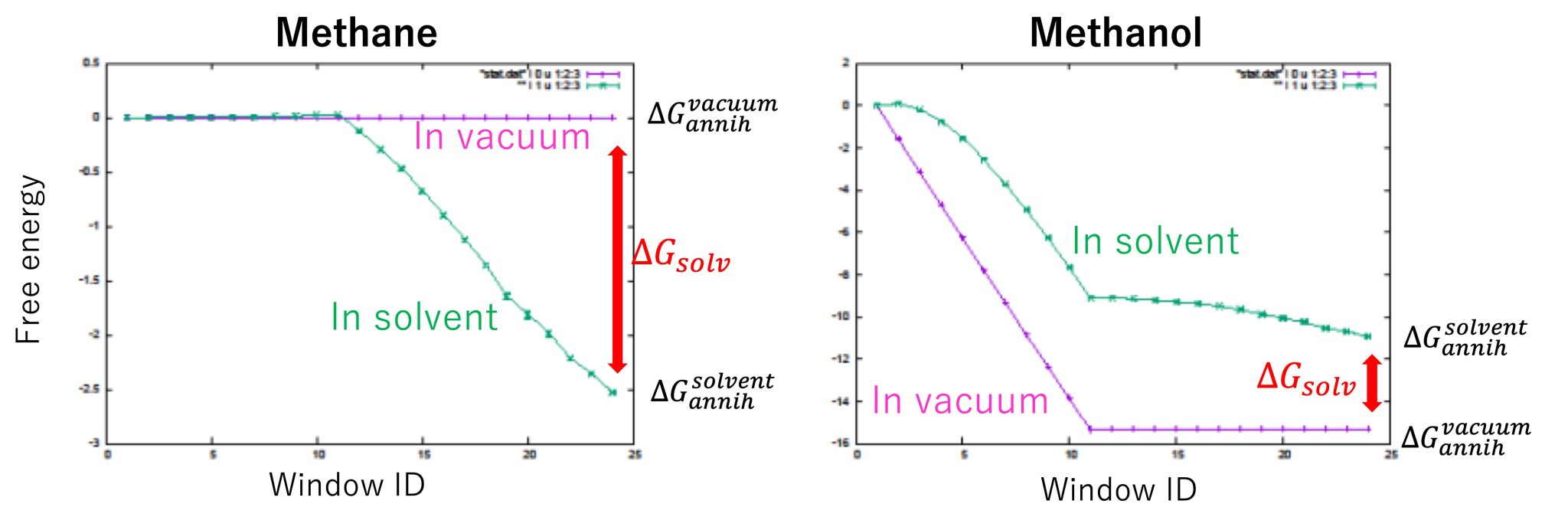
Figure 6. Free-energy changes from the initial state to the final state for “in solvent” and “in vacuum”.
Written by Hiraku Oshima@RIKEN BDR
March 31, 2022
References
-
Y. Sugita, A. Kitao, and Y. Okamoto, Multidimensional Replica-Exchange Method for Free-Energy Calculations. J. Chem. Phys. 113, 6042–6051 (2000). ↩
-
H. Fukunishi, O. Watanabe, S. Takada, On the Hamiltonian Replica Exchange Method for Efficient Sampling of Biomolecular Systems: Application to Protein Structure Prediction. J. Chem. Phys. 116, 9058−9067 (2002). ↩
-
M. Zacharias, T. P. Straatsma, and J. A. McCammon, Separation‐shifted scaling, a new scaling method for Lennard‐Jones interactions in thermodynamic integration. J. Chem. Phys. 100, 9025–9031 (1994). ↩
-
T. Steinbrecher, I. Joung, and D. A. Case, Soft-core potentials in thermodynamic integration: Comparing one- and two-step transformations. J. Comput. Chem. 32, 3253–3263 (2011). ↩
-
D. L. Mobley, J. P. Guthrie, FreeSolv: A Database of Experimental and Calculated Hydration Free Energies, with Input Files, J. Comput. Aided Mol. Des. 28, 711–720 (2014) ↩